Dinghy 12’ Fittings
Mast
Must be not
flexible but with the minimum weight. Suggestion made from different pieces and
void in the centre; diameter about 60/65 mm.
It is
important the chance to move the bottom of the mast back and forward in order
to move the sail centre and to optimize upwind capability or effort on the
rudder; provide some spacers (same as 420 o 470) in order to maintain the
correct position
Reinforces
with leather or matt and epoxy on friction points where boom and gaff are in
contact
Boom
Same as mast. Possible triangular shapes or something improving
stiffness.
Attachments
to the boom for sheet must be made with collars with the load on the upper side
of the boom. Blocks are to be attached in such a way the direction of the sheet
is perpendicular to the blocks on the boat (less effort). On the bottom part of
the boom provide a small block in order to be able to control the tension on
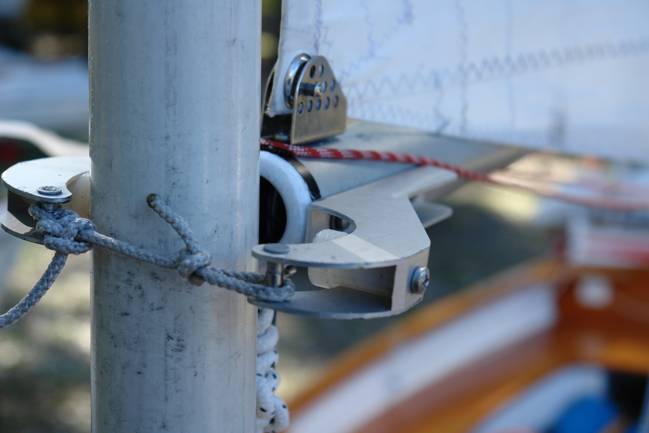
the base of the sail and to move the control to the boat. On the mast side the
attack point for the sail and the downhaul must be screwed together with
passing screws in order to pass the stress provided by the tension of the sail
(from the halyard) and downhaul and an hardware permitting to move the sail in
front or back as on picture
Gaff
Flexible,
made from different pieces laminated together in order to obtain pre-bend
(medium about 55mm).
It would be
ok to provide similar as the boom a small block on the upper part and the
capability to regulate the tension of the sail.
On the
lower part an hardware like the one fitted on the boom
in order to better control the sail.
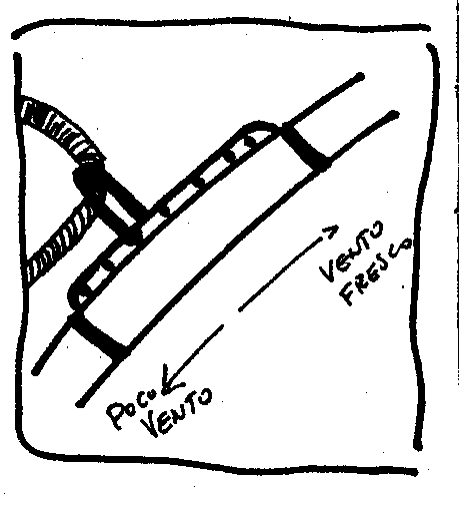
The point
where attack the halyard to the gaff in variable (according to the rules). Some
hardware (or multiple holes thru the gaff) colud be a
right solution. See example
Foot of the mast
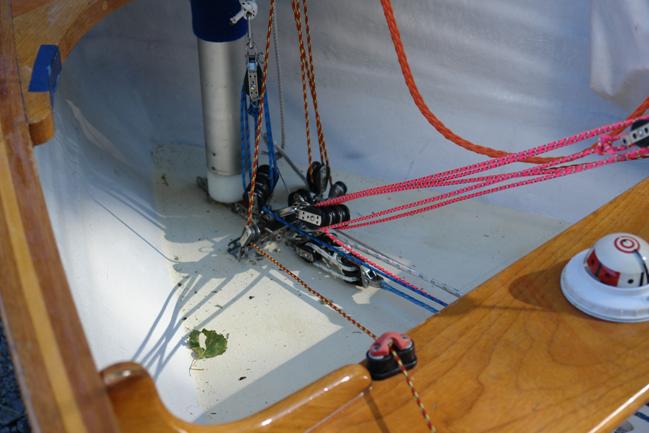
It must be
equipped in order to provide some hardware to fit in place in a proper way blockes for passing of the halyard sheet, downhaul, vang, main base tension. Remember that the downhaul must
the closest to the mast foot, the vang
must be very near in order to avoid the increasing of the tension when you open
the boom downwind. In the picture an example
Main halyard
It must be
tensioned using a 6:1 system with a spectra or Kevlar line from the gaff to the
boat ending with a loop that can be hooked with a 6:1 system fitted on the
centreboard case on one side with a camcleat for
initial fix of the halyard. Of course the halyard (same as most dinghies like
470 or similar) must have another part made of poorest stuff in order to raise
the gaff to the proper position. 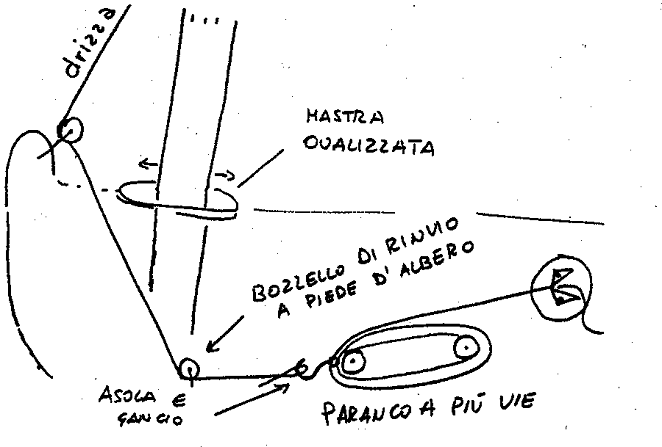
Dowh haul
4:1 or 6:1
system better on centreboard as this example
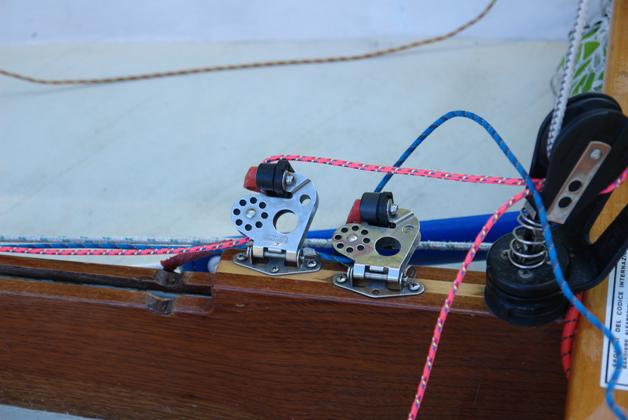
or this 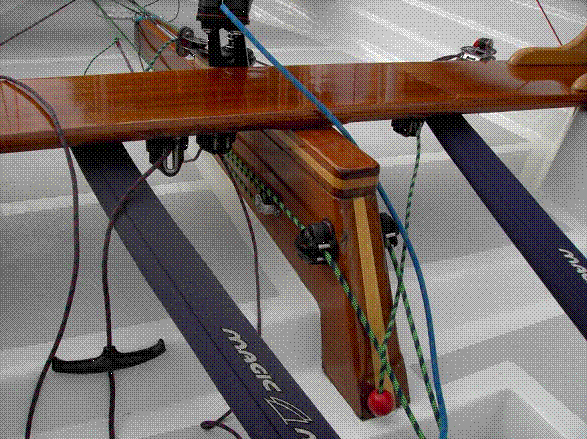
or moved
to both sides of the boat
Use micro
blocks with ball bearings like Harken micro series
Vang
4:1 system
on the centreboard (another example)
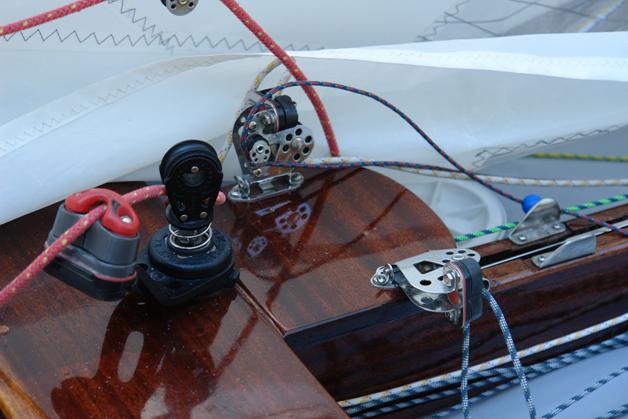
or moved
to both sides of the boat (see figure ). Use micro blocks with ball bearings
like Harken micro series
Main base tension
2:1 system
moved to the centreboard (see drawing). Use micro blocks with ball bearings
like Harken micro series
Sheet
Controlled
by a cam swivel basis such as Harken 144 or 240,
Blocks use on the bottom part of the boom a block with beckett like Harken 2637
and two blocks like Harken 2636 on the traveller and
on the front part of the boom
Pictures (to be inserted)
Basic but
functional (ITA1953 Stefano Bagni)
Full control (ITA2175 Franco Paganini
or ITA2176 Paolo Corbellini)
Hi-tech solution
(ITA2228 Enrico Negri)